Writing

This past Christmas, my parents, brother, and I giddily unwrapped a new mahjong set gifted to my mother by her family in Malaysia. The smooth, satisfying clicks of the tiles reverberated throughout the entire house as we played for hours into the night—laughing and enjoying each other’s company during the holiday season. Whether it was nostalgia kicking in or my fondness for drawing analogies, I found myself reflecting on how the game’s tactics and strategies mirrored experiences and lessons from my life up to that point.
In mahjong, the objective of the game is to obtain a winning hand consisting of 14 tiles through a continuous cycle of drawing and discarding. Various permutations allow for someone to win; thus, the challenge lies in constantly optimizing your hand to increase the probability of drawing that winning tile while also paying close attention to your opponents and their actions. It’s a fluid, fast-paced game that ebbs and flows, calling for trade-offs, perseverance, and at times, conviction in action—all of which I’ll explore below.
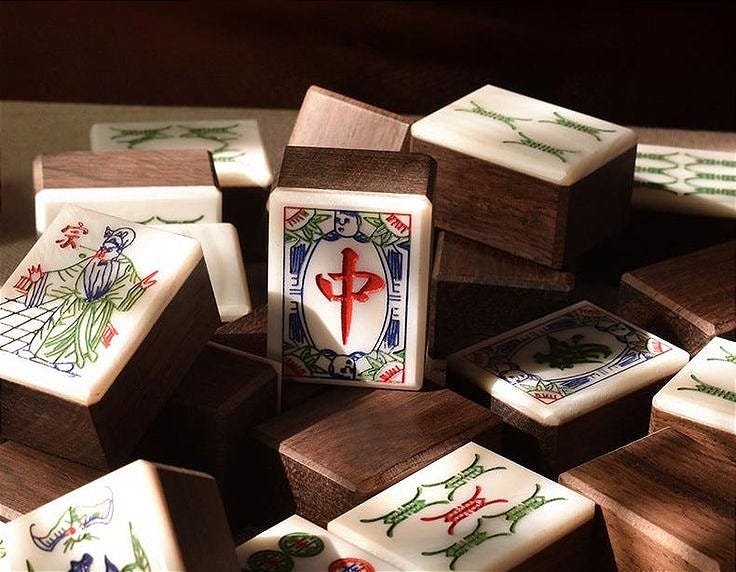
You’re dealt a hand—so it’s up to you to make do with what you have
A cliche and overstated idea, but one firmly rooted in reality. There’s no controlling the 13 tiles you’re dealt in mahjong. By luck, you might begin with a fantastic hand or, on the flip side, a terrible one. Regardless, the game must continue. Much like in life, I’ve realized we’re all dealt different hands—some good and some bad. Some of us are born into immense privilege, while others aren’t. But a strong hand doesn’t guarantee success; it merely increases the odds. What ultimately matters is how well you lean into your own idiosyncrasies to play the game and win.
There is almost always a trade-off
Recall that the objective of mahjong is to obtain a winning hand consisting of 14 tiles, yet you’re only ever allowed to hold 13. Each turn requires you to draw a tile and decide whether to keep it and forego a piece in your hand or discard it completely. The key idea is that unless your draw results in a win, or hu (胡), you must let something go. This structure forces players to make constant trade-offs.
As I’ve grown older, I’ve come to recognize that life operates the same way, particularly when it comes to time. Investing hours in a client deal that won’t yield immediate returns means losing the chance to pursue other opportunities. Eating a burger with fries might feel incredible in the moment, but the trade-off manifests itself during a workout. Some trade-offs are worthwhile; while others aren’t. As in mahjong, what matters is understanding what you’re giving up—and why.
Observe the actions of others.
One of mahjong’s greatest strengths is how players can deduce others’ intentions based on the tiles they choose to discard or take—such as pung (碰). Say, all three Dragon tiles have already been discarded, it becomes clear that holding onto your own Red Dragon tile is futile. There’s no viable path to a winning combination, and you can also infer that your opponents aren’t pursuing that strategy.
It’s through others’ actions—or their inaction—that intentions reveal themselves. I think of friendships that unraveled quietly, where the smallest gestures, compliments withheld, affection left unreturned, said more than any argument could. Whether at the mahjong table or elsewhere, observing the actions of others may provide greater clarity and insight into how to move forward.
Stop to smell the flowers
In mahjong, flower tiles can’t be used to complete a hand, yet they offer their own quiet value and are set aside as the player draws again. Drawing a flower momentarily pauses the rhythm of the game, providing some respite from the rapid cycle of draw and discard. Their worth isn’t immediate, but each flower tile carries monetary value that’s added to a player’s score at the end when everything is tallied—a reminder that what looks like a pause can still be a form of gain.
We all have our own version of flower tiles. Between long work hours, training for races, meal prepping, and balancing other priorities, I often feel exhausted come Friday night. While the act of doing is fulfilling, it’s just as important to allow pauses. Whether it’s taking time to listen to music or play piano, these unhurried moments of reflection and recalibration have paid dividends later, through clarity and a steadier sense of direction as the work week begins again.
Have conviction in your path and don’t be fickle
While flexibility is critical in mahjong, so is commitment to a strategy. Imagine holding a solid hand when, midway through the game, other players begin discarding an entire suit. The temptation to abandon your plan and pivot is strong. I’m guilty of falling into this trap—and more often than not, it’s cost me the game. Had I remained steadfast in my original strategy, I might have won with the hand I already had.
This lesson extends beyond mahjong. We live in a world with an overabundance of choice. There’s an incessant yearning to be everything, do everything, buy everything, and achieve everything, further amplified by social media that creates the trap of comparison and decision paralysis. Yet there is virtue in conviction and consistency.
This year, I hope to embody that principle in my career, choosing a path that aligns with my values rather than measuring myself against peers following more traditional routes. My goals may look different, but I have conviction that my choice is right for me, and that staying the course will ultimately lead to a win.
I’m writing this, most likely coming across as a mahjong expert of some sort. The truth is, of the 20+ rounds I played this past Christmas, I only won one. But by deeply studying the game and having conviction in myself, I’m curious how I’ll fare this upcoming Christmas.
When my kitchen fills with the clicking of shuffled tiles, my parents heckle one another, and my brother quietly strategizes to himself, only one question remains: Who will win the first game?